Whatsapp:
+(86) 186-2049-9733
E-mail:
service@himalayaicetech.com
Global Factory HQ:
South Zone, 4th Floor, Building 1, Runzhi Technology Park, Taishan Road, Nanhai District, Foshan, Guangdong, 528200 China

Whatsapp:
+(86) 186-2049-9733
E-mail:
service@himalayaicetech.com
Global Factory HQ:
South Zone, 4th Floor, Building 1, Runzhi Technology Park, Taishan Road, Nanhai District, Foshan, Guangdong, 528200 China
B2B Water Chiller Engineering Guide
Cold plunge chiller size should be selected from the complete thermal load — not water volume or horsepower alone. Himalaya IceTech chiller configurations span 0.5HP to 5HP, from compact cold plunges to heavy-duty commercial recovery projects.
As an engineering starting point, 0.5–1HP can suit smaller residential systems, while 1–1.5HP is commonly considered for medium-size plunges or applications requiring faster cooling.
1.5–2HP becomes increasingly appropriate for larger water volumes, lower target temperatures, hot climates and repeated daily use.
For hotels, recovery centers, gyms, sports facilities and other high-use projects, 2.5HP, 3HP and up to 5HP heavy-duty chillers can be specified according to water volume, hourly user load, ambient temperature, target temperature and required recovery time.
These are engineering starting ranges only. Final selection should be based on rated cooling capacity in kW or BTU/h, actual water flow, insulation and operating conditions rather than HP alone.
These overlapping ranges are intentionally broad. Water volume is only the starting point; ambient temperature, target temperature, cooling time and commercial user load can move the project into a larger capacity class.
| Water Volume | Typical Application | Starting Range | Engineering Consideration |
|---|---|---|---|
| 150–300 L | Compact home plunge | 0.5–0.8HP | Best suited to insulated tubs, moderate ambient temperatures and lower user frequency. |
| 250–400 L | Residential cold plunge | 0.8–1HP | Suitable where moderate pull-down time and residential daily use are acceptable. |
| 300–500 L | Premium home / light commercial | 1–1.5HP | Consider larger capacity for lower target temperature, faster cooling or warmer climates. |
| 400–700 L | Recovery studio / repeated use | 1.5–2HP | Commercial user heat load and recovery time begin to become major sizing factors. |
| 500–800 L | Commercial cold plunge / hot climate | Around 2HP | Evaluate ambient temperature, hourly users, insulation, condenser ventilation and target temperature. |
| 700–1,000 L | High-use commercial | 2.5–3HP | Better suited to larger water volume, higher user turnover and shorter recovery requirements. |
| 1,000 L+ | Heavy-Duty Commercial / custom recovery facility | 3–5HP | Project-specific thermal-load calculation is recommended. User turnover and operating hours should be included. |
Engineering starting points only. Nominal horsepower is not a universal refrigeration-capacity measurement. Compare manufacturer-rated cooling capacity, test conditions and complete system design.
Two 500-liter cold plunges can require completely different chiller configurations when their installation conditions and commercial usage are different.
More water contains more thermal energy. A 700-liter plunge requires more heat removal than a 300-liter plunge under otherwise identical conditions.
Cooling from 25°C to 10°C is fundamentally different from cooling the same water to 5°C or approaching 0°C.
A plunge operating outdoors in 40°C heat has a much greater thermal load than the same system operating in a 25°C indoor environment.
Cooling overnight requires less instantaneous capacity than bringing a large plunge to operating temperature within only a few hours.
Every user adds heat to the water. Commercial facilities therefore need enough capacity to recover between consecutive sessions.
Poor insulation continuously adds heat to the water and increases compressor runtime, energy use and required cooling capacity.
Dirty filters, restrictive fittings, undersized plumbing or inadequate pumps can reduce actual heat-transfer performance.
Direct sunlight, enclosure ventilation, condenser airflow, equipment-room temperature and outdoor exposure all influence real-world chiller performance.
Example: cooling 500 liters from 25°C to 5°C requires removing approximately 11.6 kWh of thermal energy from the water before accounting for environmental heat gain, plumbing losses, user load or other real-world factors.
This is why refrigeration capacity in kW or BTU/h provides more meaningful engineering information than the HP label alone.
Labels such as 0.5HP, 1HP, 1.5HP, 2HP, 3HP or 5HP are useful for product comparison, but two chillers carrying the same HP label may use different compressors, heat exchangers, condenser designs, refrigerants and water-flow architectures.
For B2B procurement, request rated cooling capacity in kW or BTU/h together with the water temperature and ambient conditions under which the rating was obtained.
The correct capacity moves upward as water volume, temperature difference, ambient heat load and commercial user frequency increase.
Suitable as a starting class for smaller insulated cold plunges and lower-frequency private use in moderate operating environments.
ResidentialA common class for medium-size insulated cold plunge systems where user frequency and ambient load remain relatively moderate.
Home + StudioAppropriate when lower target temperatures, faster pull-down or repeated daily use require more thermal capacity.
Light CommercialA stronger starting point for larger water volumes, commercial use, rapid pull-down and demanding ambient-temperature conditions.
CommercialDesigned for larger plunge volumes, increased hourly user turnover and facilities requiring stronger temperature-recovery performance.
High FrequencyDesigned for large-volume cold plunges, demanding commercial facilities and projects requiring substantial thermal recovery. Final sizing should consider peak user load, operating hours, ambient conditions, electrical infrastructure and service strategy.
Heavy DutyCooling-time claims become useful only when the operating conditions are disclosed alongside the result.
This is a specific engineering example, not a universal cooling-time guarantee. Actual results vary with ambient temperature, circulation, plumbing, insulation, starting temperature and system configuration.
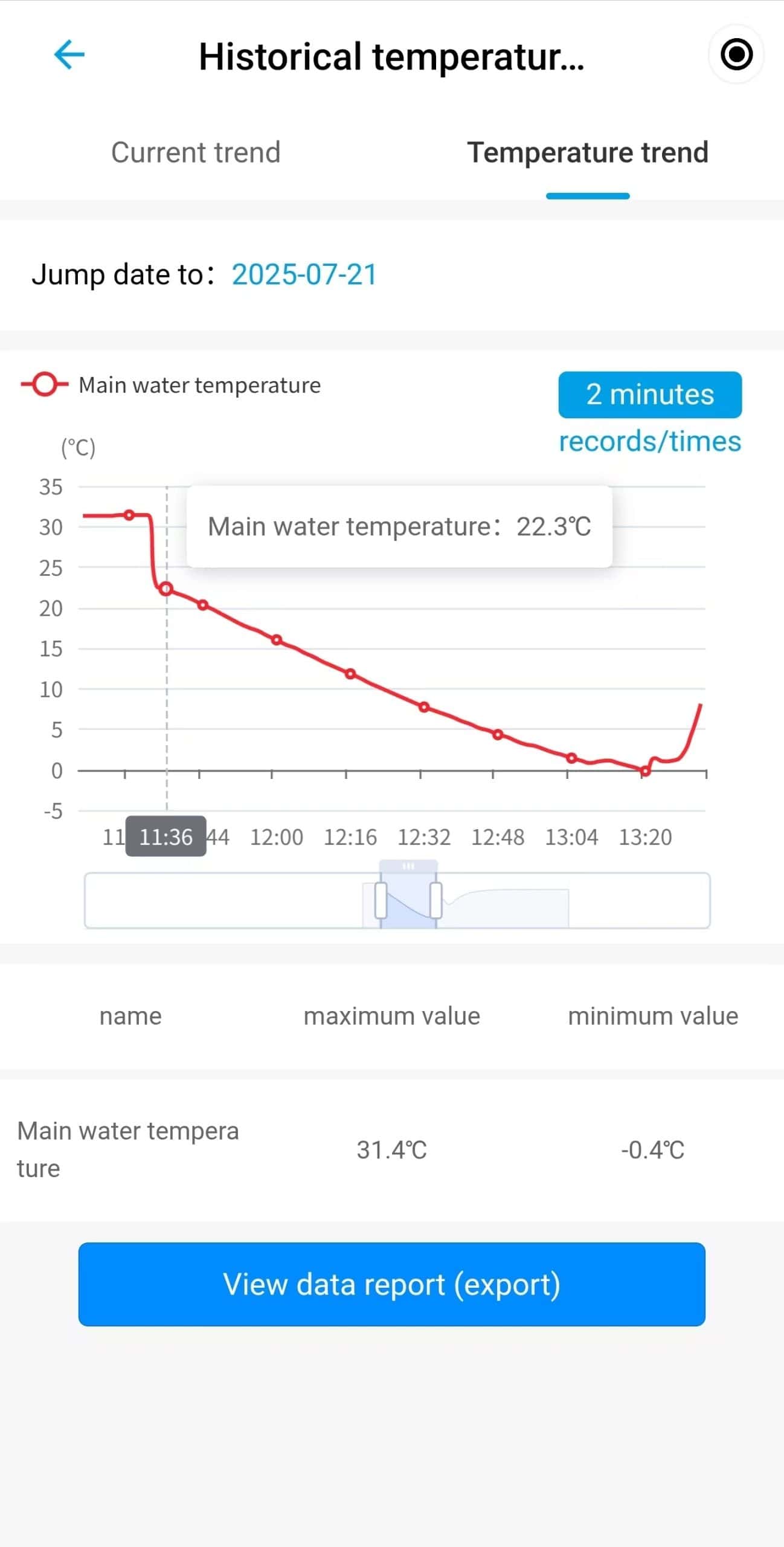
A chiller may cool an empty tub successfully but still struggle when users continuously introduce heat throughout the operating day.
Low user frequency provides more time for temperature recovery. A smaller capacity can therefore be acceptable when rapid pull-down is not required.
Repeated users create additional thermal load. Chiller capacity, flow and insulation should be selected to restore the target temperature between sessions.
Longer operating hours and variable customer frequency generally justify additional thermal recovery capacity.
Large commercial projects using 2.5HP–5HP systems should be evaluated from peak hourly users, daily operating hours, target recovery time, ambient conditions, redundancy and long-term serviceability.
Equipment selected for a moderate indoor environment should not automatically be expected to provide identical performance outdoors in extreme summer conditions.
compressor operating range, condenser capacity and airflow, equipment ventilation, solar exposure, tub and plumbing insulation, target water temperature, compressor duty cycle and expected commercial user load.
A high-ambient or T3 configuration may be more meaningful than simply increasing the nominal HP number.
Refrigeration capacity becomes useful only when heat can move efficiently from the plunge water through the heat exchanger.
Dirty filters increase hydraulic resistance and may reduce effective system flow.
Small hoses and unnecessary restrictions increase pressure loss and reduce circulation.
Pump sizing should consider the complete system resistance, not the free-flow pump rating alone.
Ice-forming systems require particular attention to circulation, freeze protection and hydraulic stability.
Send your actual project conditions. Himalaya IceTech can provide a project-specific engineering starting point instead of recommending a chiller from water volume or horsepower alone.