Whatsapp:
+(86) 186-2049-9733
E-mail:
service@himalayaicetech.com
Global Factory HQ:
South Zone, 4th Floor, Building 1, Runzhi Technology Park, Taishan Road, Nanhai District, Foshan, Guangdong, 528200 China

Whatsapp:
+(86) 186-2049-9733
E-mail:
service@himalayaicetech.com
Global Factory HQ:
South Zone, 4th Floor, Building 1, Runzhi Technology Park, Taishan Road, Nanhai District, Foshan, Guangdong, 528200 China
0.5–5 HP+ · Residential · Commercial · OEM / ODM
Looking for the right ice bath chiller? Himalaya IceTech manufactures water chillers for home plunges, commercial recovery facilities and private-label brands. Our range covers compact 0.5–1 HP systems, commercial 1.5–2 HP models and heavy-duty 3–5 HP+ projects, with selected 0°C, heating and water-treatment configurations.
Already know what you need? Talk to us on WhatsApp
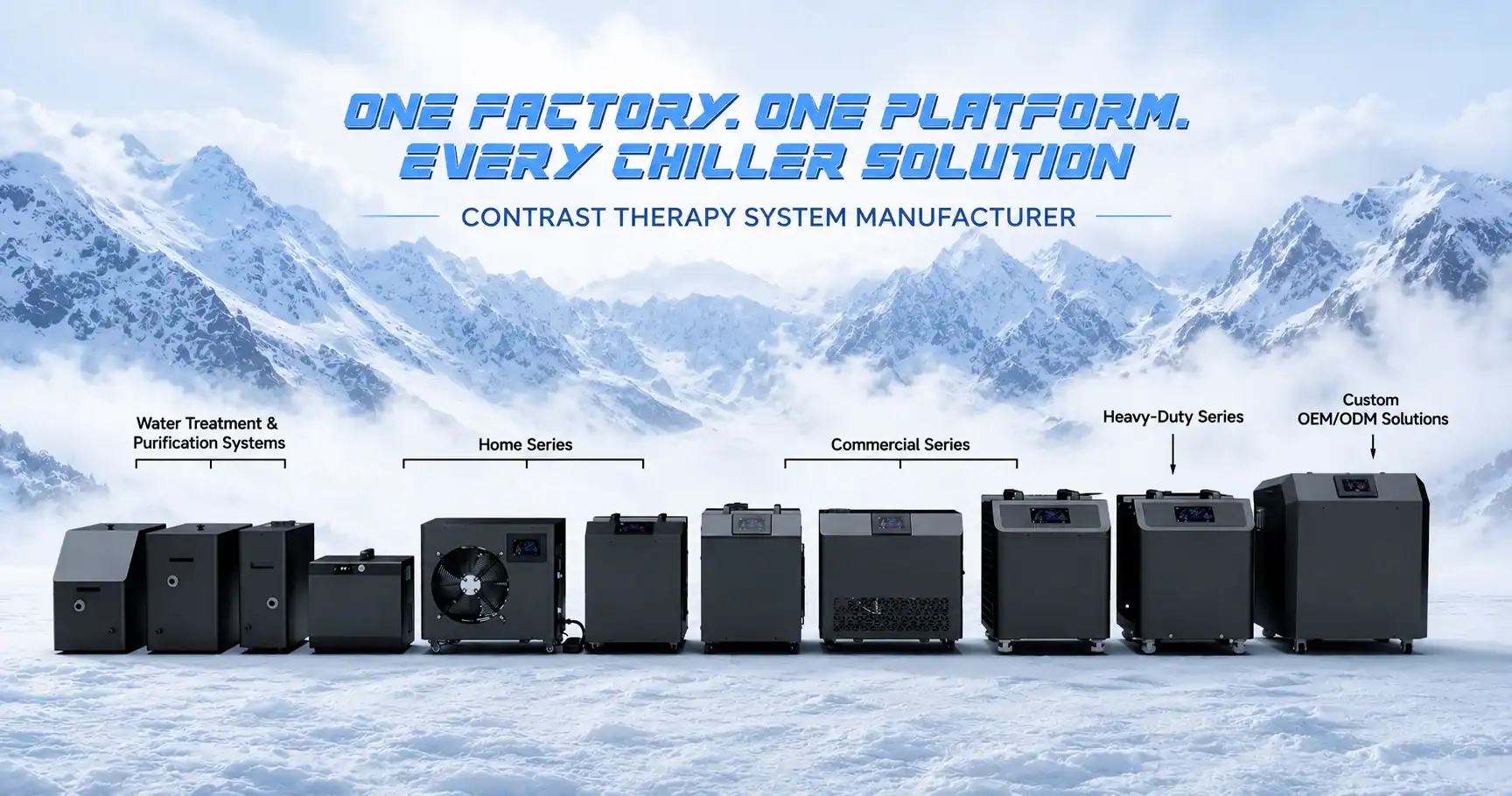
Cooling performance depends on the complete installation—not horsepower alone. Water volume, climate, insulation, ventilation, circulation and target temperature all matter.
Quick answer
An ice bath chiller is a refrigeration and circulation system that continuously removes heat from plunge water, allowing the bath to stay cold without constantly adding bags of ice.
The important part is choosing the right system for the real job. A 300 L home plunge used once a day and a busy commercial recovery facility may both need cold water, but they do not place the same demand on the chiller.
That is why we look at water volume, starting temperature, target temperature, ambient climate, insulation, daily users, water flow and filtration before recommending a model.
Chiller sizing
If you are comparing 1 HP, 1.5 HP and 2 HP units, start with the job the machine needs to do—not the number on the label. The right recommendation comes from the full operating conditions.
01 / Start with the target
Holding a plunge around 8–10°C is a very different job from bringing water down to 0°C. Tell us the temperature you really need and how quickly you expect the system to get there.
The size of the plunge and the number of people using it each day directly affect cooling and recovery demand.
A machine operating outdoors in a hot climate needs very different planning from one installed indoors in a cool room.
Pipe length, pump flow and filter resistance all affect the circulation rate through the chiller.
If dozens of people use the plunge every day, the system has to recover temperature repeatedly—not simply reach the target once.
Configuration A
Compact systems for qualified home, sample and lighter-duty plunge applications.
Explore residential chillers →Configuration B
More cooling capacity for larger water volumes, repeated daily use and projects that need faster recovery.
Explore commercial chillers →Configuration C
Project-engineered systems for larger installations, demanding climates and high commercial loads.
Explore heavy-duty chillers →Unsure which size is right? Send us the water volume, country, target temperature and expected number of daily users. That is usually enough to start.
Ask our team →Documented performance
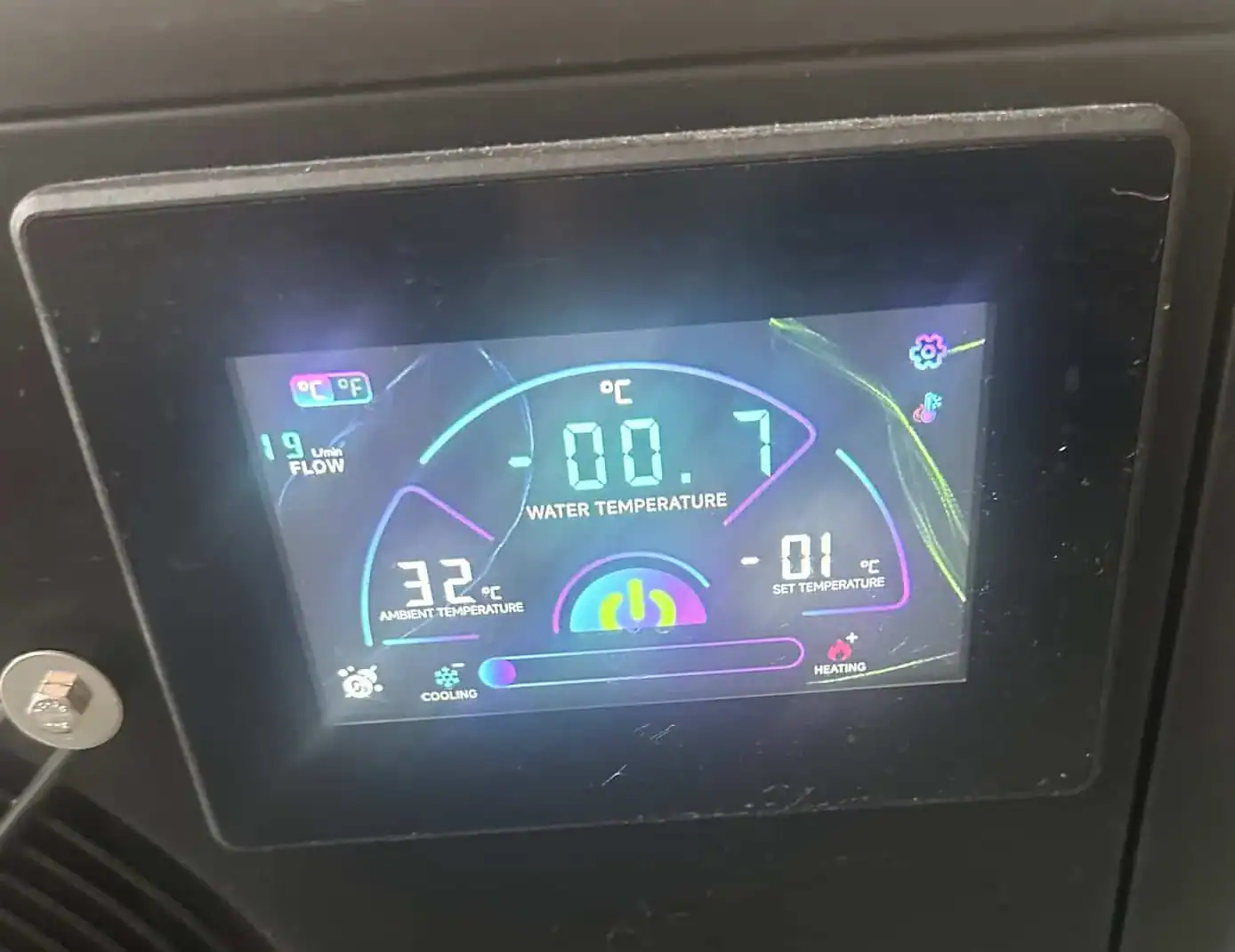
Rather than only quoting laboratory cooling capacity, we also test complete plunge systems. In this recorded run, a 2HP T3 chiller cooled a 350 L insulated plunge at an ambient temperature of approximately 35°C.
Test conditions
This is one documented real-world configuration—not a promise that every installation will cool at exactly the same rate. Water volume, airflow, insulation, piping and climate can all change the result.
| Chiller | 2HP T3 |
|---|---|
| Water volume | 350 L |
| Plunge | Insulated tub with cover |
| Ambient temperature | Approximately 35°C |
| Recorded start | 31.4°C at approximately 11:00 |
| Recorded minimum | -0.4°C at approximately 13:20 |
| Elapsed period | Approximately 2 hours 20 minutes |
| End condition | Ice formation observed |
Supporting temperature evidence
The temperature history gives a second view of the same test. It records the cooling trend and shows the recorded maximum of 31.4°C and minimum of -0.4°C.
We keep the original record available so buyers can look beyond a headline cooling claim and see the actual data behind it.
View the full temperature record →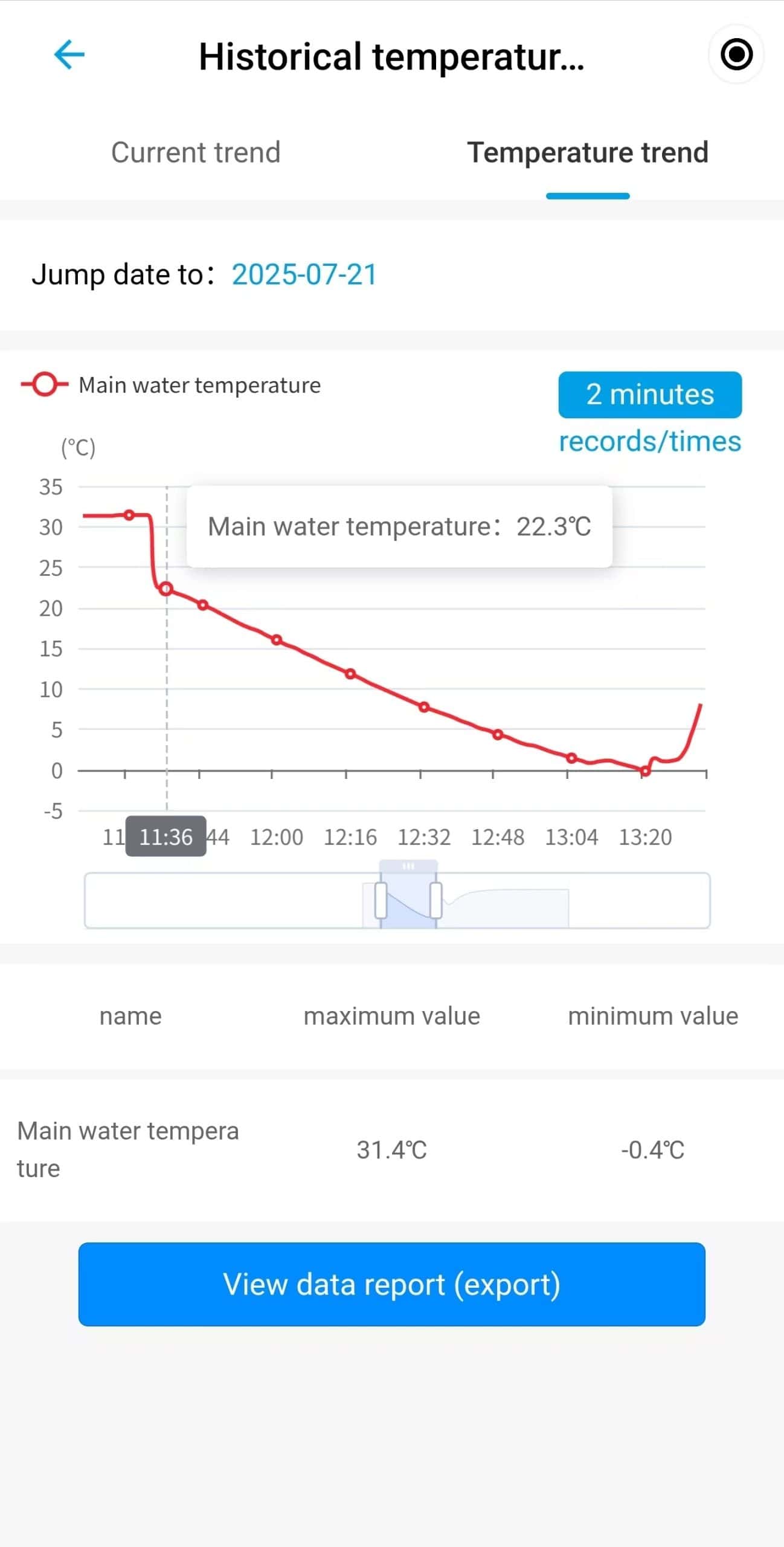
Test results apply to this documented configuration. Cooling time in another installation may vary with water volume, ambient temperature, insulation, ventilation, piping and circulation.
Water treatment
Cooling the water is only part of the job. In a good cold plunge installation, the chiller, pump, filtration, sanitation and pipework should work together as one system.
Refrigeration capacity is selected around the expected water temperature, climate and daily workload.
Good flow matters. Pump capacity, pipe diameter and filtration resistance all affect heat transfer through the system.
Filters should be easy to reach and maintain, especially in a commercial facility where downtime matters.
Additional water-treatment technologies can be integrated according to the hygiene requirements and usage level of the project.
Complete system integration
If you prefer one supplier to coordinate the complete system, we can match the plunge, chiller, pump, filtration and controls before the equipment leaves the factory.
Volume, insulation, inlet and outlet positions and service access.
Cooling capacity matched to climate, temperature and usage.
Filtration, UV, ozone or AOP according to the project.
Electrical configuration, interface, branding and documentation.
Building a complete cold plunge product? Tell us what you want the customer experience to be, and we can work backwards from the finished system.
Discuss the system →Dual-zone contrast therapy
For contrast-therapy projects, one integrated platform can be configured around a cold plunge and a heated plunge while keeping the two water circuits separate.
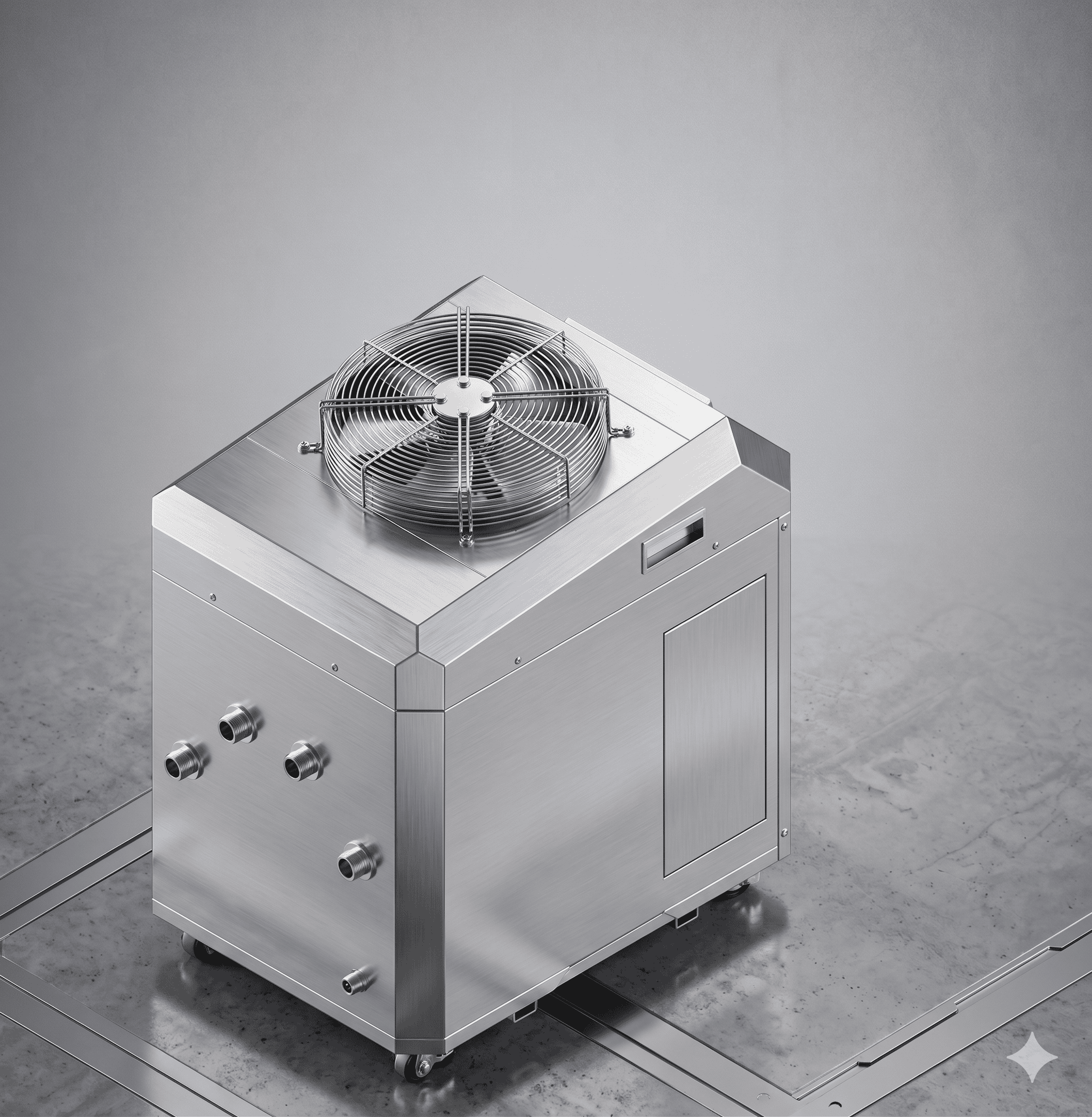
Dual-Core Thermal™
Instead of treating the hot and cold sides as two unrelated systems, the project can be coordinated around one equipment platform while maintaining separate water routes for the two plunges.
OEM / ODM
Some customers only need private labeling. Others want a different exterior, control interface, pump configuration, water-treatment system or complete tub-and-chiller platform. We can work at either level.
Browse the range
Start with the closest duty level below. If your project sits between two categories, send us the operating conditions and we will help narrow it down.
Compact systems for home plunges and lighter-duty applications.
Explore residential chillers → 02 / 1.5–2 HPBuilt for gyms, hotels, spas and higher-frequency recovery use.
Explore commercial chillers → 03 / 3–5 HP+Larger cooling systems for demanding climates and higher loads.
Explore heavy-duty chillers → 04 / CustomPrivate-label and project-specific cooling-system development.
Explore OEM / ODM →Buyer questions
These are the questions we hear most often from distributors, commercial operators and brands before they choose a chiller.
Start with five things: water volume, starting temperature, target temperature, ambient climate and expected daily use. We also check insulation, ventilation, pipe length, pump flow and local voltage. Horsepower matters, but choosing only by HP is one of the easiest ways to end up with an undersized—or unnecessarily oversized—system.
In our documented 350 L test, the plunge was insulated and covered, with an ambient temperature of approximately 35°C. The recorded water temperature fell from 31.4°C at about 11:00 to -0.4°C at about 13:20. Ice formation was visible near the end of the run. You can review both the original video and the temperature record on this page.
There is no single HP rating that is “best” for every cold plunge. A lightly used home tub and a commercial recovery facility have very different loads. The right chiller depends on water volume, target temperature, climate, insulation, recovery time and how many people will use the plunge each day.
Yes. Depending on the project, we can combine the chiller with filtration, circulation pumps, UV, ozone or AOP water treatment. We prefer to look at the whole water route together, because pump flow, pipe resistance and filtration all affect how well the system works in real use.
Compact 0.5–1 HP units are generally better suited to qualified residential and lighter-duty projects. A 1.5–2 HP commercial system gives more cooling capacity for larger water volumes, faster recovery and repeated daily use. We still recommend checking the actual operating conditions before choosing the final model.
Selected Himalaya IceTech ice-making configurations can reach 0°C / 32°F under suitable conditions, and our documented 2HP T3 test recorded water below 0°C. Actual performance will still depend on water volume, ambient temperature, insulation, ventilation and the way the system is installed.
Yes, selected models support both cooling and heating, with operating ranges up to 42°C / 108°F depending on configuration. If you need both functions, tell us at the beginning of the project so we can match the correct refrigeration and control system.
It is an integrated thermal platform designed around one cold plunge and one heated plunge, with separate water circuits for each side. The idea is to simplify the overall contrast-therapy installation while keeping the hot and cold water routes independent.
Yes. We offer commercial configurations for hotels, spas, gyms, recovery centers, sports clinics and wellness facilities. For these projects we pay particular attention to repeated daily use, temperature recovery, water flow, filtration, ventilation and maintenance access—not just the initial pull-down time.
Yes. The project can be as simple as private labeling, or it can include exterior design, controls, electrical configuration, filtration, packaging, manuals and a complete tub-and-chiller system. We normally define the scope first and then build the sample around the final product you want to sell.
Depending on the model and destination, compliance support can include CE, EMC, LVD, RoHS, UKCA, CB and Australian RCM / SAA requirements. Because certification scope varies by electrical configuration and market, please tell us the destination country before ordering so we can confirm the exact documents for your model.
Request a recommendation
You do not need to know the exact HP before contacting us. Send the information you already have, and we will help narrow down the right configuration.
Prefer a direct conversation?
service@himalayaicetech.com · WhatsApp +86 186 2049 9733
Add the operating conditions if you have them. If not, tell us what you know and we will help from there.
By submitting, you agree that Himalaya IceTech may use the information provided to respond to your inquiry. View our Privacy Policy.